How to Get Stains and Garlic Smell Out of a Wood Cutting Board
Lift deep stains and lingering odors from a wood cutting board with salt, lemon, and baking soda, then re-oil it so it stops absorbing them.
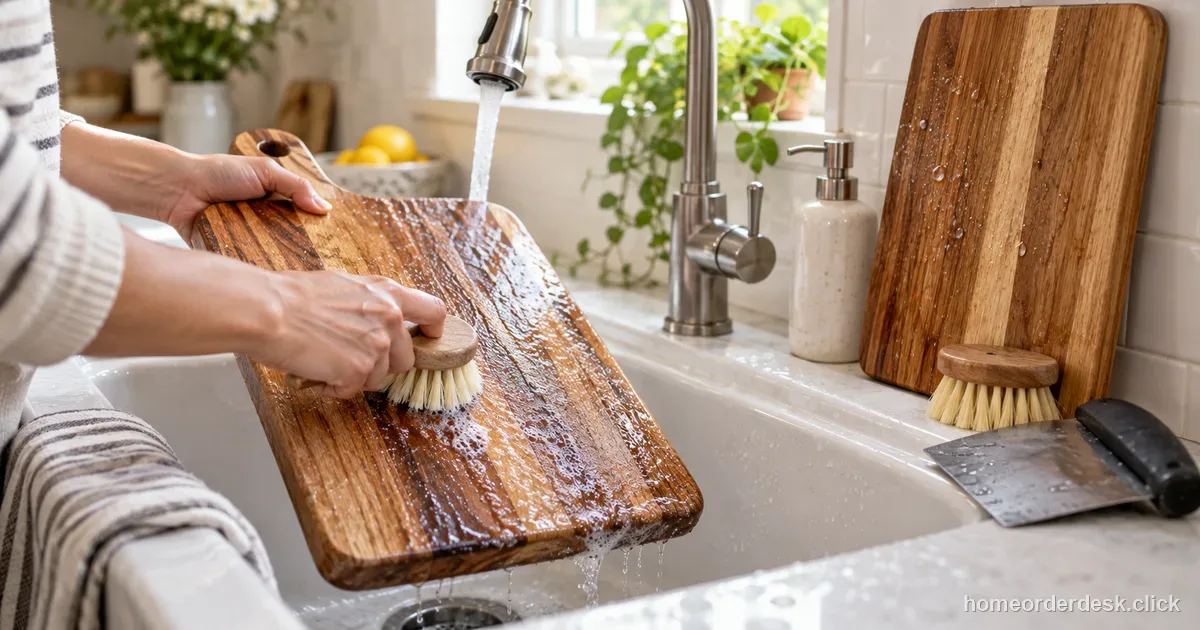
A wood cutting board that has been used for a while picks up dark stains from beets, berries, turmeric, and tomato, and a smell of garlic, onion, or fish that survives ordinary washing. Both problems come from the same cause: wood is porous, and a board that has dried out or lost its oil finish soaks up pigment and odor into the surface fibers. The fixes are mild abrasives and acids for what is already in there, and re-oiling so it stops happening.
Wash it right first
Wash the board with hot, soapy water and a brush right after each use, then rinse and air-dry it on edge. Hand-washing is the safe default: do not soak a wood board. USDA says some solid-wood boards can go in a dishwasher if they are dishwasher-safe and have no cracks or deep scratches; laminated boards may split. Follow the board maker’s care label, especially for bamboo and glued boards.
A properly washed board that still smells or looks stained needs the deeper treatment below.
Salt and lemon for stains and smell
Sprinkle coarse salt generously over the board, then rub it in with the cut face of half a lemon, squeezing a little juice as you go. The salt is a gentle abrasive that scours the top layer of fiber, and the lemon's acid neutralizes odor compounds and lifts some pigment.
Work it over the whole surface, let it sit for five to ten minutes, then scrape off the paste with a bench scraper and rinse. This handles most garlic and onion smell and lightens fresh stains noticeably.
Baking soda paste for stubborn stains
For a dark set stain that salt and lemon do not clear, make a paste of baking soda and a little water, spread it thickly over the stain, and let it sit 15 minutes or so. Scrub it in with a brush along the grain, then rinse.
Baking soda is mildly abrasive and alkaline, which works on different residues than the lemon's acid. You can do the lemon pass and the baking soda pass on the same board; just rinse between them.
Sanitize only with a food-contact method
After raw meat, poultry, or seafood, first wash and rinse the board. USDA FSIS recommends flooding a clean wood or plastic board with a solution of one tablespoon unscented liquid chlorine bleach per gallon of water and letting it stand for several minutes; rinse with clear water and air-dry or pat dry. A commercial product is suitable only when its label specifically allows use on food-contact boards or utensils, and you follow any rinse directions.
Do not pour household 3 percent hydrogen peroxide on the board and call it sanitized. It may fade some pigment, but that is different from a validated food-contact sanitizer. A dishwasher is an option only if both the board maker and its material condition allow it.
Deep scratches and a rough surface
Over time, knife cuts leave the surface furry and full of grooves that trap food and moisture. If the board is thick enough, you can sand it smooth: work through progressively finer sandpaper, from around 120 grit to 220, sanding with the grain, then wipe off all the dust with a damp cloth and let it dry fully.
A board that has cracked through, has deep splits, or has a grey-black discoloration deep in the wood should be retired from food use, as those cannot be cleaned to a safe state.
Re-oil so it stops absorbing
All of the above removes some of the board's oil, and an unoiled board is a sponge for the next stain and smell. Once the board is clean and bone dry, rub in a generous coat of food-grade mineral oil, or a board cream made of mineral oil and beeswax, let it soak in for a few hours or overnight, and wipe off the excess.
Re-oil a board monthly with regular use, or whenever water stops beading on the surface and instead soaks in and darkens the wood.
End-grain versus edge-grain boards
An end-grain board, the checkerboard-looking kind, has the wood fibers standing vertically like a bundle of straws, so it absorbs and releases moisture readily and needs more frequent oiling but is kinder to knives. An edge-grain or face-grain board has the fibers running flat and is a little more water-resistant. Both stain and hold odor when dry, and both are cleaned the same way, but an end-grain board especially should never be left wet or soaked, because the open fiber ends drink water and the board can split along a glue line.
Bamboo boards are technically a grass, glued in strips, and are harder and less absorbent than hardwood but also more prone to surface cracking and glue failure with heat and prolonged water. Treat bamboo like a wood board: hand-wash, dry on edge, and oil it, and retire it if the strips start to separate.
| End-grain | Edge- or face-grain | |
|---|---|---|
| Fiber direction | Fibers stand vertically like straws | Fibers run flat |
| Moisture | Absorbs and releases moisture readily; dry promptly | A little more water-resistant |
| Care | Hand-wash by default; dishwasher only if maker approves and board is sound | Hand-wash, dry on edge, and oil as directed |
When a board is past cleaning
A board that has cracked through its thickness, has deep splits that trap food, has soft or spongy spots, or shows grey-black discoloration deep in the wood should be taken out of food use. Those conditions cannot be cleaned to a safe state, and sanding will not reach discoloration or damage that runs deep. A board with only surface roughness and shallow knife marks, though, can usually be sanded smooth and re-oiled back into service.
After every one of these deeper treatments, and after any sanding, the board will be drier than it was because the salt, acid, and abrasion all strip some of its oil. Let it dry completely, then rub in a generous coat of food-grade mineral oil or a mineral-oil-and-beeswax board cream, let it soak in for a few hours or overnight, and wipe off whatever has not absorbed. A board that is kept properly oiled resists the next round of stains and smells because the oil fills the pores that would otherwise soak them up.
Follow the board maker’s label; deep damage cannot be sanitized by stain treatment.
Keeping a board in good shape
Use one board for raw meat and another for produce and bread, wash and dry both promptly, never soak them, and keep them oiled. A well-maintained board resists stains and odor because the oil fills the pores that would otherwise absorb them.
Frequently asked questions
How do I get garlic and onion smell out of a wood board?
Try coarse salt and lemon, then rinse well. Scrub gently along the grain and dry the board fully; retire it if deep cracks or hard-to-clean grooves remain.
Can a wood cutting board go in the dishwasher?
Follow the board maker’s care label. USDA says some solid-wood boards may be dishwasher-safe if sound and without deep cuts; laminated boards may split. Hand-wash unless your exact board is approved.
How do I sanitize a board after raw meat?
Wash and rinse it first. USDA FSIS recommends one tablespoon of unscented liquid chlorine bleach per gallon of water, left on the board for several minutes, followed by a clear-water rinse and drying. Commercial products must be labeled for food-contact boards or utensils.
Does household hydrogen peroxide sanitize a cutting board?
Do not treat household 3 percent peroxide as an equivalent food-contact sanitizer. Use the USDA method or a commercial product labeled for boards and utensils, following its directions.