How to Remove Burnt-On Sugar and Scorched Milk From a Glass Cooktop
Choose the model-specific response to a sugar spill, then soften and lift cooled deposits with only the cleaner and tool approved for your cooktop.
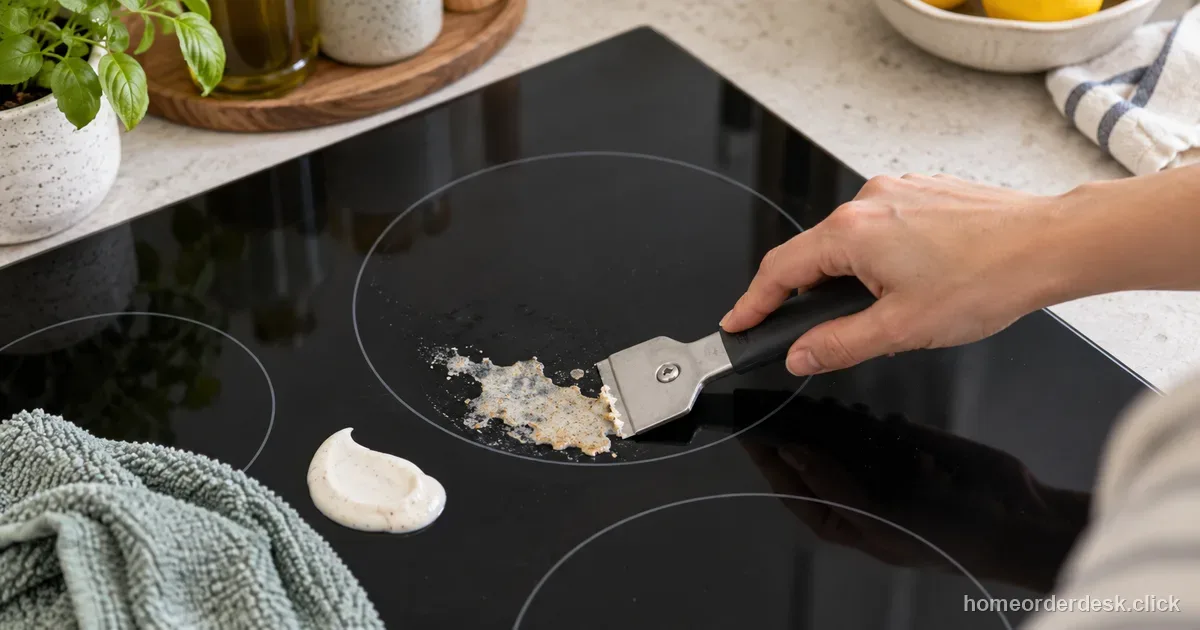
A boiled-over pot of syrup or milk can leave a fused deposit on a ceramic-glass cooktop, but the correct removal method differs by model: some manufacturers specify scraping a sugar spill while warm or hot, while others warn that a scraper can damage a coating. Find the appliance model and read its cleaning instructions before touching a warm surface. Do not apply a generic temperature rule to every glass top.
Check the manual before treating sugar
If your manual tells you to remove melted sugar promptly with a cooktop scraper, follow its timing, tool, angle, and burn-protection directions exactly; switch off the affected zone and use an oven mitt if directed. Never touch molten sugar with bare skin. If the manual calls for a cool surface, prohibits scrapers, or you cannot identify the model, keep away from the hot zone and contact the manufacturer for the approved method. The photo and diagram here show a cool-surface scraping example, not permission to scrape a hot appliance.
Do not touch hot sugar with bare skin; it sticks and burns badly. If the sugar has already hardened, move to the cool-surface method below.
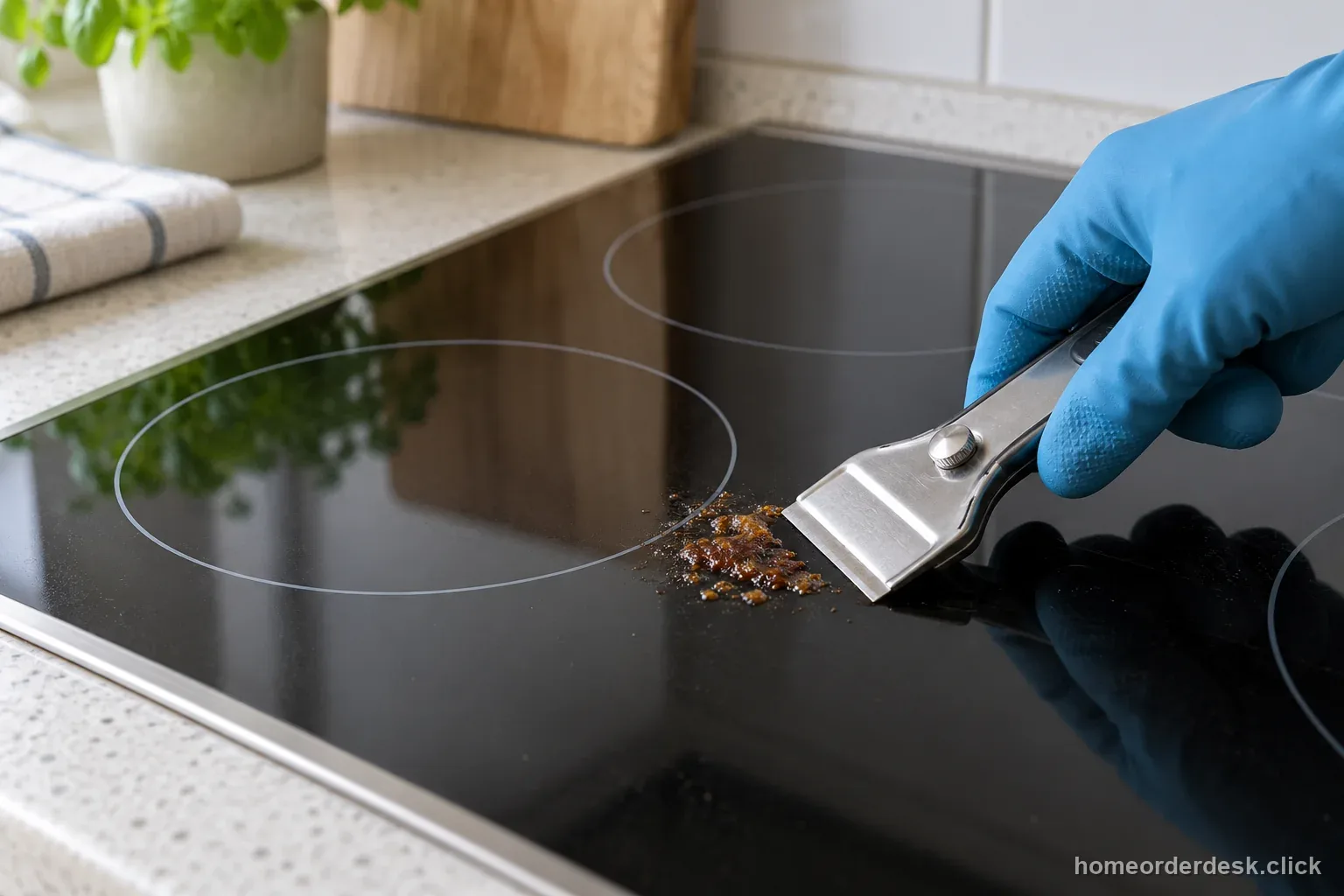
Models differ: some permit a guarded scraper while warm; others caution that scraping may damage the coating.
Let a milk or food spill cool, then soften it
For scorched milk, sauce, or hardened sugar, first switch the controls off and let the surface cool unless the exact appliance manual gives a different spill-specific instruction. Check that manual before applying water, cleaner, or a tool: some glass tops have a coating that can be damaged by a scraper, while others specify a scraper and a particular timing. If the manual does not describe the deposit, ask the manufacturer before trying a soak or blade.
A damp cloth or a soak is not a universal cooktop method. Use one only if the manual permits it, and follow its cleaner, cloth, and contact-time directions. Do not add dish soap or leave a wet cloth on a coated surface unless the instructions allow it.
Cream cleaner and a flat blade
If the manual approves a ceramic-glass cream cleaner, apply it as directed. Use a scraper only when the manual permits it for the exact cooktop and residue. Follow its blade type, angle, direction, and safety instructions; published manufacturer directions differ, so there is no safe universal angle or scraper rule. Do not substitute a knife, spatula, or unguarded blade.
If the manual permits scraping, remove only the loosened residue using the specified tool and technique. Stop if the surface changes, the scraper catches, or the deposit does not lift; do not press harder or repeat a method the manufacturer has not approved.
Polish off the haze
After cleaning, remove any product residue exactly as its label and the appliance manual direct. Some makers recommend a soft dry cloth; others specify a different finish step. Do not add a second coat or assume cleaner leaves a protective layer unless your cooktop instructions say so.
- Cool and softenFor milk, food, or hardened sugar, cover the deposit with a hot soapy cloth for 10 to 15 minutes.
- Add cooktop creamApply only the model-approved ceramic-glass cleaner after the surface is cool, unless the manual says otherwise.
- Push with a flat scraperUse a scraper only if the appliance manual allows it; follow its angle and stroke instructions.
- Buff the residueAfter the deposit lifts, buff away cleaner haze with a clean dry microfiber cloth or paper towel.
What never to use
Do not assume a tool or cleaner is safe because the surface looks like ordinary glass. Avoid steel wool, abrasive pads or powders, melamine erasers, oven cleaner, and household chemicals unless the manual explicitly approves them for your model. Some coated glass tops prohibit scrapers; others prescribe a specific cooktop scraper for particular residue. Use only that approved tool, and keep it away from children.
Do not clean a cooktop that has a visible crack or chip; a compromised surface can fail under heat.
Water spots and rainbow discoloration
Cloudy, rainbow, or brown marks can have different causes, and appearance alone does not identify the residue or prove that the glass is undamaged. Do not reach for vinegar, a scale remover, or a scraper based on color alone. Check the model instructions for the specific mark, and stop if it remains after an approved cleaning method. Ask the manufacturer or an appliance technician if the glass is pitted, cracked, or chipped.
Everyday cleaning between spills
For routine care, switch the cooktop off and wait until it is cool, then follow the manufacturer’s cleaning method. If the manual permits a damp soft cloth, use a clean one and dry the surface as directed. Wipe spills promptly when safe to do so; do not let a later heating cycle bake residue onto the glass. This can reduce buildup but cannot prevent every mark.
Use a cooktop cream only if the manual recommends or allows it, and follow the cleaner label for amount, application, and removal. Do not set a weekly schedule or expect a protective coating unless the appliance maker specifies one. If the finish or cleanability changes, stop and contact the manufacturer.
Protecting the surface from scratches
Lift pots rather than sliding them, especially cast iron and stoneware with rough bases, and check pan bottoms for stuck-on grit or burnt residue before setting them down. Never use the cooktop as a landing spot for anything with a hard or gritty underside, and keep the area around it free of the salt and sugar granules that turn an innocent slide into a scratch. Keep only the exact model-approved cleaner and tool together near the stove, stored safely away from children and heat. Check the manual before using the scraper on a new kind of spill.
If it helps, keep the approved cleaner, any model-approved scraper, and a clean soft cloth in a safe nearby place. A general cooktop kit is not automatically suitable for every surface; do not use a blade or product until you have checked the exact manual.
Preventing the next boil-over mark
Wipe spills off with a damp cloth as soon as the surface is cool enough to touch, before they get a chance to bake on with the next use. Choose cookware and cooking settings according to the appliance manual and recipe. Stay nearby when heating sugary mixtures or milk, and turn the controls off if a spill occurs; follow the model’s instructions for any hot spill.
Frequently asked questions
Should I clean a sugar boil-over while the cooktop is still hot?
Check the manual for your exact model. Some manufacturers instruct you to move a sugar spill while the surface is warm or hot with a specified scraper and oven mitt; other surfaces can be damaged by scrapers. Follow the appliance instructions, and do not touch hot sugar.
How do I remove a scorched-milk deposit without scratching the glass?
Check the manual for your model before using water, cleaner, or a scraper. If it allows a cool-surface cloth or cleaner, follow its product and contact-time directions. Use a scraper only if the manual approves it, and follow its tool and technique instructions; stop if the residue resists.
Can I use a magic eraser or scouring pad on a glass cooktop?
Avoid abrasives unless the appliance maker explicitly permits a specific product. Scraper guidance also differs: some coated cooktops prohibit them, while other manuals approve a particular scraper for certain residue. Use only the tools and cleaner allowed for your exact model.
There's a rainbow or brown sheen on the cooktop. Can I remove it?
A rainbow or brown appearance does not identify its cause. Use only the method the appliance manual approves for that mark. If it remains, or the glass is pitted, cracked, or chipped, stop and ask the manufacturer or a qualified appliance technician.