How to Organize Hand Tools Without Building a Fancy Workshop
Give hand tools and small hardware visible homes near the work they support while keeping heavy equipment stable and batteries appropriately stored.
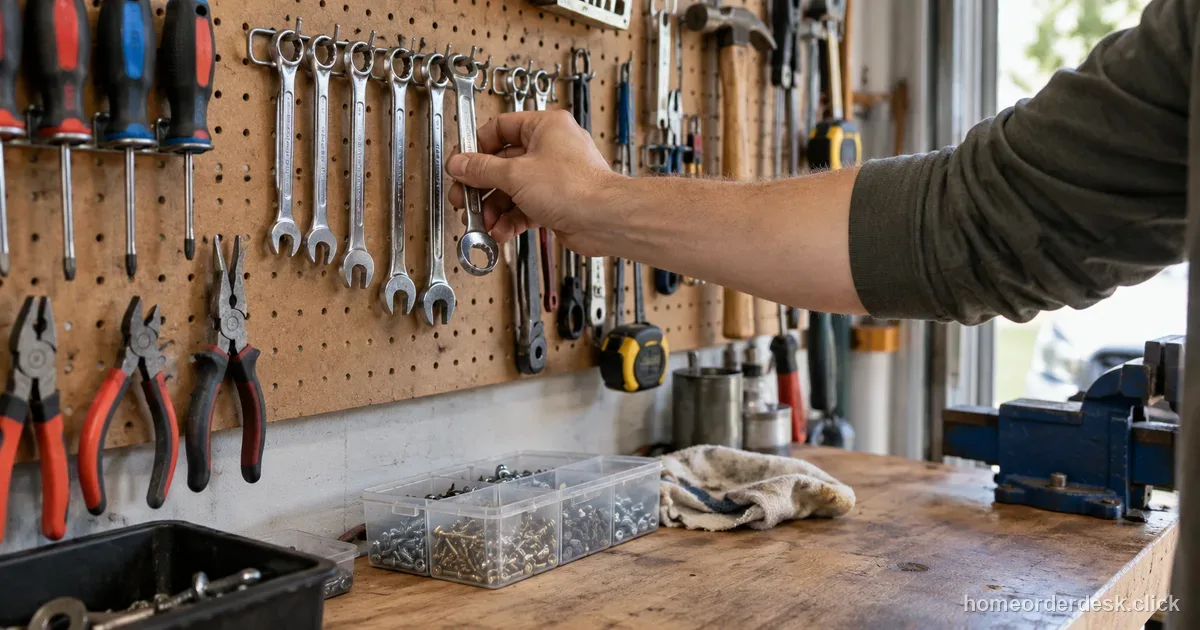
Hand tools do not need a showroom workshop to be organized. They need a home that matches the jobs you actually do, keeps sharp edges controlled, protects tools from moisture, and makes it obvious when something is missing. Start with the tools, not the pegboard: a person with a drill, wrenches, and a hammer needs a different system from someone maintaining engines every weekend.
Sort tools by job and frequency
Create groups such as measuring, fastening, cutting, electrical, automotive, and general repair. Within each group, separate weekly tools from specialty pieces. This exposes duplicate screwdrivers and mystery parts that otherwise fill every drawer and helps you see which categories actually deserve prime workbench access.
Use the lightest storage that keeps the tool easy to return and safely supported.
Give the most-used tools a one-motion return
A hammer, tape measure, utility knife, and common pliers may belong on a wall strip, shallow top drawer, or portable caddy near the work surface. Tools used twice a year can live deeper. If putting a tool away requires opening three boxes, it will end up on the bench.
For a pegboard or wall rail, check the panel, hook, and mounting instructions together. On finished walls, use the specified backing or spacers and secure the system to appropriate structure; do not assume the panel or a single hook can carry any tool that fits. Keep heavy items on stable, load-rated shelves or drawers, and place frequently used tools where the person using them can reach without stretching over a work surface.
Control sharp edges and powered tools
Store saws, blades, drill bits, and other sharp accessories with edges covered and in a closed or otherwise child-inaccessible home that fits your household. Remove a battery only when the tool maker recommends it. Store removable battery packs in their designated case or with terminals protected as the maker directs, away from loose metal objects. Stop using a battery that is bent, crushed, swollen, leaking, or otherwise damaged and ask the manufacturer how to handle it; do not improvise a repair.
Remove batteries when the tool maker recommends separate storage. Do not toss loose batteries where their terminals can contact metal tools.
Use shallow drawers for small dense parts
Sockets, hex keys, drill bits, and precision tools are easier to scan in shallow drawers or divided trays than in one deep, mixed compartment. Label by size only when that label helps a real task. Leave enough room to pick up one item without dumping the entire compartment.
Protect metal tools from garage moisture
A damp garage can rust steel tools. Fix leaks, avoid storing tools directly on a wet floor, and keep them clean and dry after use. For valuable hand tools, follow the maker's corrosion-prevention instructions rather than spraying every surface with an unknown oil.
Make the workbench a working surface
Set a rule for what may remain on the bench between projects. A correctly matched charger can have a designated station, but charge batteries only as their maker directs and avoid leaving damaged packs or chargers in the project tray. Unrelated tools return to their homes. The ability to start a repair without first clearing yesterday's pile is a useful measure of whether the storage system works.
Give fasteners their own inventory logic
Screws, nails, anchors, washers, and nuts become hard to identify when mixed in one coffee can. Use small clear compartments labeled by broad type and size, and keep manufacturer packaging when it contains important load or material information. Do not rely on corroded, damaged, or unidentified fasteners for a repair that depends on their strength; replace them with hardware specified for the job.
Keep manuals and specialty jigs near the tools they support
A router guide, drill jig, calibration wrench, or tool-specific manual can disappear if paperwork is stored across the garage. Use a labeled pouch, drawer, or digital copy tied to the tool. The item should be findable when the tool is used, not when the entire garage is reorganized.
Use empty slots as a missing-tool signal
A socket rail, peg outline, or divided tray can show immediately when something has not returned. This matters more than visual neatness. If the 10 mm socket is always missing after automotive work, give it a defined slot and check the tray before closing the job.
Expand storage only when the tool collection genuinely changes
If a new hobby adds a real category such as woodworking, create a dedicated zone then. Do not buy a wall of cabinets for a small tool set in anticipation of future projects. Empty cabinetry quickly becomes a magnet for unrelated household overflow.
Build one portable repair kit for jobs away from the bench
Many household fixes happen upstairs, outside, or beside an appliance rather than at the workbench. A small caddy with the few tools repeatedly carried around the house can save trips without duplicating the whole collection. Return those tools to the caddy after each job and keep specialty tools in their main storage. The portable kit should be light enough to carry safely and should not include loose blades where hands reach blindly.
| Main tool storage | Portable repair kit | |
|---|---|---|
| Best fit | Full collection, specialty tools, and protected precision equipment | A few tools repeatedly carried away from the workbench |
| Where it lives | Wall strip, shallow drawer, divided tray, or protected case near the task | One caddy light enough to carry safely |
| After a job | Return tools to their visible home or checkout spot | Return kit tools to the caddy and specialties to main storage |
Give measuring and precision tools a protected home
Levels, squares, torque tools, meters, and other measuring equipment can be damaged by drops, moisture, or being buried under heavier hardware. Use cases or drawers that protect them and follow manufacturer guidance for calibration, battery removal, or storage. These tools deserve organization based on accuracy, not merely on shape.
Cap consumables before they become another hardware pile
Sandpaper, blades, tapes, glues, drill accessories, and small repair consumables multiply because replacements are bought before old stock is checked. Give each broad type a bounded drawer or bin and keep packaging when it contains size or compatibility information. Before buying more, check the category. An organized tool wall can still fail if every drawer underneath is filled with duplicate consumables.
A practical tool system supports work away from the bench, protects precision equipment, and keeps consumable stock visible enough that replacement purchases are deliberate.
Return borrowed and shared tools to a visible checkout spot
If neighbors or family members regularly borrow tools, use one small “out” note, hook, or tray so an empty slot has an explanation. Record who has the item and roughly when it should return. This prevents buying a duplicate simply because the original wrench or drill has temporarily left the garage.
Create a small staging area for active projects
Tools often become “clutter” because a repair or build is genuinely still in progress. Instead of forcing every item back into permanent storage after each short work session, define one bounded project tray or bench zone for the tools and parts needed for the current job. Label the project and clear the zone when it finishes. This keeps the rest of the bench from becoming indefinite staging. Separate borrowed tools so they are returned promptly, and keep chargers or batteries in locations that follow manufacturer guidance. A visible active-project area is useful; five overlapping abandoned projects are simply another storage problem.
Frequently asked questions
What tools deserve the most visible storage?
Frequently used hand tools should be reachable near the workbench or task area, while specialty tools can live in labeled drawers or cases farther away.
How should small fasteners be stored?
Use shallow labeled compartments so screws, anchors, washers, and bits are visible without dumping a mixed container onto the bench.
Where do tool batteries belong?
Follow the tool and battery maker’s storage, charging, and disposal guidance. Keep removable packs in their case or protect terminals as directed, and contact the manufacturer about a damaged pack.
How can I tell whether the tool system is working?
After a project, every common tool should have an obvious return location. If the bench becomes the default parking place, reduce categories or improve the nearest storage point.