How to Declutter Household Paper Without Losing Important Records
Separate action papers, permanent records, tax documents, personal information, and routine mail so the household inbox stops becoming storage.
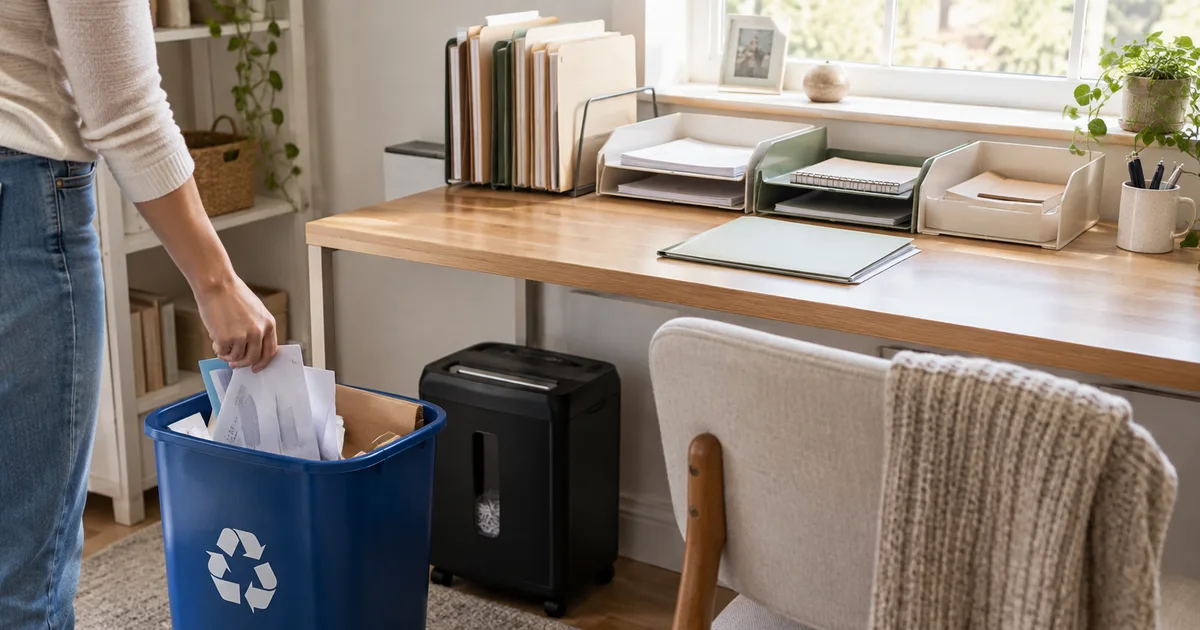
Household paper should be decluttered by retention need and next action, not by the size of the pile. Bills, tax records, warranties, medical documents, school notices, junk mail, and sentimental letters have different lifetimes. The safest process protects identity information, preserves records with a real legal or financial purpose, and removes routine paper quickly.
Set up action, file, shred, and recycle destinations
Use four clearly separated piles or containers while processing. Action is for something that must be paid, signed, called, or scheduled. File is for records with an identified retention reason. Shred is for sensitive paper no longer needed. Recycle handles non-sensitive routine paper. Do not create a generic 'important' pile that mixes all four.
Process mail where it enters the house
Open mail near recycling and the action tray. Discard envelopes and inserts that have no value immediately. Put bills or forms into the action system with due dates rather than leaving them in an inbox. Stopping paper at the door is easier than decluttering six months of unopened mail later.
Use record-specific retention guidance
Tax records, employment documents, insurance information, home-improvement receipts, and medical paperwork can have different retention needs. IRS and other official guidance should inform tax-document decisions. When a record has legal, warranty, or claim implications, verify the required period before shredding.
Protect identity information
Documents with Social Security numbers, account numbers, medical details, signatures, or other sensitive data should be stored securely while needed and destroyed appropriately when no longer required. FTC identity-theft guidance supports careful handling of personal information. Open recycling is not the right destination for sensitive paper.
Scan only when digital storage has a retrieval plan
Scanning every sheet can replace physical clutter with thousands of unsearchable files. Use descriptive file names, dates, and a few broad folders. Back up important files. Keep originals when law, policy, or practical use requires the paper document rather than assuming a scan is always equivalent.
| Original paper | Digital copy | |
|---|---|---|
| Best fit | The original may be required or costly to replace | A searchable, backed-up record is useful and acceptable for the purpose |
| What to preserve | Secure storage and the record-specific retention reason | A clear file name, date, broad folder, and backup |
| Before destroying the other form | Verify the retention need before shredding | Do not assume scanning makes the original equivalent |
Separate sentimental paper from administrative files
Letters, children's art, certificates, and photographs deserve a different decision from bank statements. Give memory paper a limited archival box or album. Mixing sentimental material into the household file cabinet makes routine filing harder and increases the chance meaningful items are discarded during a hurried purge.
Create a tax-year closing routine
When a tax year is complete, gather supporting records into one labeled file or digital folder and remove duplicates. Keep the retention schedule with the file so future-you knows when it can be destroyed. This prevents tax records from remaining permanently simply because no one remembers the appropriate end date.
Match warranties with the item they support
A warranty without a receipt, product serial number, or ownership context may be useless. Keep appliance and home-improvement documents together by product or property project. When the item leaves the home, review its paperwork at the same time rather than preserving manuals for products you no longer own.
Run a kitchen-counter example through the four destinations
Recycle flyers, place two bills in the action tray with due dates, file the current insurance declaration, shred an outdated account statement, and move a child's drawing to the memory folder. The counter becomes clear because each paper follows a rule, not because everything moves into one larger basket.
Schedule a recurring file review
Choose a review rhythm that matches how much paper enters your home. Empty the action tray, file completed items that need retention, shred sensitive records whose verified need has ended, and remove duplicates. Keep the review short enough to repeat so a file box does not become a permanent archive of every sheet that once felt important.
Separate originals that are difficult to replace
Some documents matter because the original itself may be required or burdensome to replace: identity records, certain certificates, signed legal documents, vehicle or property records, and similar papers. Identify those separately from ordinary statements or reference copies. Store them securely according to their importance rather than scanning everything and assuming the paper can automatically be destroyed.
Use return windows and warranty dates to control receipts
Receipts often linger because nobody knows when they stop being useful. Attach or scan a receipt with the related warranty or purchase record when there is a clear reason to keep it, and note the return or warranty period. Routine low-value receipts can leave once their purpose is over, subject to any tax, reimbursement, or account requirements. A date-based review keeps receipt folders from becoming permanent archives.
Keep a basic household inventory separate from daily paperwork
Photos, serial numbers, or purchase information for significant household property can support insurance or replacement needs. Keep that inventory in a secure, backed-up location rather than in the kitchen mail pile. Update it when major items enter or leave. This is a distinct record set with a clear purpose, which makes it easier to protect without preserving every instruction leaflet and sales brochure.
Destroy expired sensitive records on a schedule
When a folder reaches its verified review date, decide whether a current rule, claim, or legal need still requires it. If not, use an appropriate secure-destruction method for sensitive pages. Scheduled destruction is what keeps a carefully organized file system from becoming a permanent warehouse of old personal data.
Paper control improves when originals, short-lived receipts, household records, and expiring sensitive documents each have a clear reason to remain and a clear point when that reason ends.
Scan selectively rather than converting every pile into digital clutter
Digitizing can reduce physical volume, but scanning hundreds of routine statements without a naming and retention plan simply moves the problem to a hard drive. Scan documents when a digital copy is useful, legally acceptable for your purpose, and easier to protect or retrieve. Name files consistently with dates and subjects, keep backups for important records, and delete obsolete scans during the same review cycle. Sensitive records need secure storage whether paper or digital. For tax and legal material, follow the relevant retention guidance rather than assuming that scanning means the original can always be destroyed immediately.
- As mail arrivesRoute it to action, file, shred, or recycle and enter due dates immediately.
- When a tax year closesGather the year's records, remove duplicates, and keep the verified retention schedule with the file.
- During your regular reviewClear completed actions, file records with a reason to stay, and remove expired temporary papers.
- At a verified review dateRecheck current claims or legal needs, then securely destroy sensitive records no longer required.
Keep records for an identified purpose and destroy sensitive material securely when its need ends.
Frequently asked questions
What are the first paper categories to separate?
Create distinct groups for action items, permanent or legal records, tax-related material, short-term reference, and papers that can be recycled or shredded.
How do I know what financial records to keep?
Use the retention guidance from the relevant institution or agency rather than an arbitrary household rule; IRS guidance is a useful reference for tax records.
Which papers should be shredded instead of recycled intact?
Documents containing sensitive personal, account, tax, medical, or identity information should be destroyed securely when they are no longer needed.
How do I keep the paper pile from rebuilding?
Use one inbox and a recurring processing day. Mail should either trigger an action, enter a defined record category, or leave the house rather than migrate between surfaces.